| Section |
NH3
|
H2O
|
H2
|
Total
|
| Condenser |
20.33
|
0
|
0
|
20.33
|
| Evaporator inlet |
1.516
|
0
|
18.814
|
20.33
|
| Evaporator outlet |
2.36
|
0
|
17.97
|
20.33
|
| Generator top |
15.54
|
4.79
|
0
|
20.33
|
It has been
assumed that vapours leaving generator top are in equilibrium with
entering rich solution at 40 C, at which temperature saturation pressure
of NH3is 15.45bar. It has also been assumed that the temperature at
evaporator inlet is -25 C at which temperature saturation pressure of
NH3 is 1.516bar.
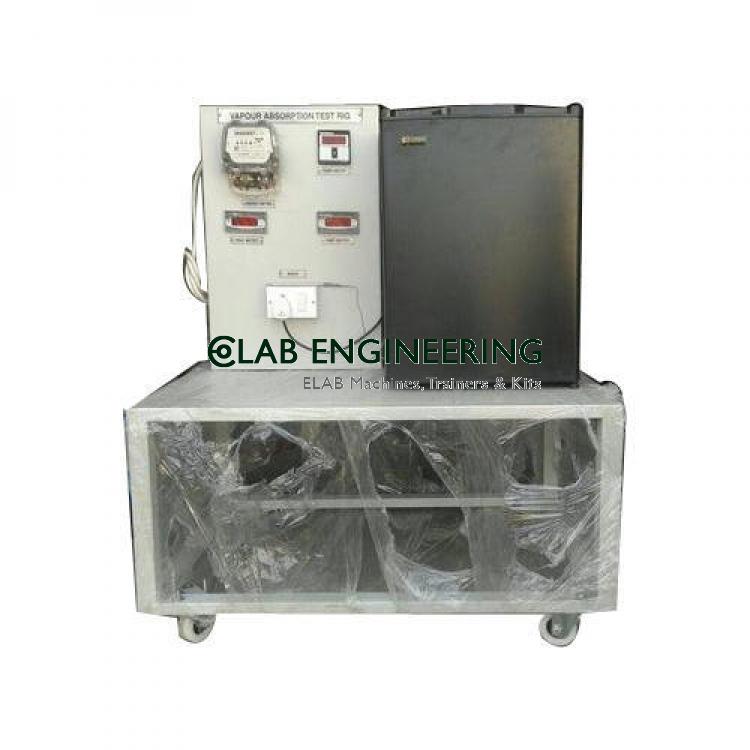
TECHNICAL SPECIFICATIONS OF VAPOUR ABSORPTION SYSTEM
| GROSS VOLUME | : | 41 LITERS |
| REFRIGERANT | : | WATER, AMMONIA, HYDROGEN |
| GENERATOR | : | ELECTRICALLY HEATED |
| CONDENSER | : | NATURAL CONVECTION TYPE |
| EVAPORATOR | : | NATURAL CONVECTION TYPE |
| MATERIAL OF CONSTRUCTION SUPPLY |
: : |
M.S. 230 VOLTS, 50 HZ, 1 PH |
| ENERGY CONSUMPTION | : | 1.07 KWH PER 24 HRS |
| ENERGYMETER | : | PROVIDED |
| TEMPERATURE INDICATOR | : | DIGITAL INDICATOR AT THE SALIENT POINTS |
Similar items like VAPOUR ABSORPTION TEST RIG you may view
ELAB Engineering is a leading manufacturer, supplier and exporter of vapour absorption test rig and a complete range of engineering laboratory and technical training equipment. We supply high-precision, lab-grade instruments in bulk to engineering colleges, universities, technical institutes and industries across 55+ countries — with competitive tender pricing, full export documentation and reliable after-sales support.
As a leading manufacturer, supplier and exporter, we deliver tender-grade quality with documented compliance to institutions, laboratories and training facilities across 55+ countries.
Every unit is manufactured to international quality standards and tested before dispatch, with QC documentation and calibration certificates included.
Established export channels across Africa, Asia and the Middle East, with complete shipping documentation, certificates of origin and customs paperwork.
We offer customisation for tender specifications, OEM branding, voltage variants and bulk institutional orders to match your exact requirement.
Technical consultation before purchase, installation guidance, operator training documentation and responsive after-sales support from our team.
Trusted by institutions, governments and industries worldwide for reliable, tender-documentation-ready supply.
Practical laboratory training & coursework experiments
STEM education & physics / chemistry / biology demos
Process quality, testing & calibration requirements
Clinical lab, diagnostics & pathology applications
Ministry, defence research & PSU lab infrastructure
UNICEF, WHO, UNDP & bilateral aid procurement
Skill development & technical training labs
Direct & sub-contractor tender fulfilment
ELAB Engineering is a recognised manufacturer, supplier and exporter of VAPOUR ABSORPTION TEST RIG. We supply this product across our complete export network — from individual institutional purchases to large-scale tender supply contracts.
All shipments include complete export documentation, customs paperwork & freight handling.
Request a custom quote, full technical datasheet, or place a bulk / tender enquiry. Our specialists respond within 1 business day with pricing, lead time and export documentation.
Common questions from buyers, procurement officers and technical evaluators about ordering, customisation, lead time and documentation.